After prolonged use, the inner wall of a teacup will accumulate a layer of yellowish tea stains.
What exactly is tea stain?
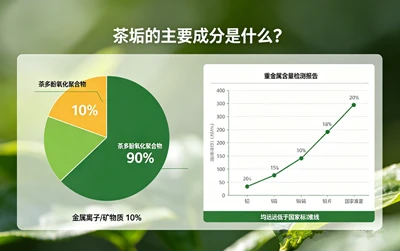
Many people mistakenly believe that tea stains are water stains or dirt from tea leaves, but this is incorrect. According to experimental analysis conducted by the Tea Research Institute of the Chinese Academy of Agricultural Sciences, the main component of tea stains is the polymer formed after the oxidation of tea polyphenols, accounting for more than 90% of the total. Less than 10% consists of a small amount of metal ions and minerals.
When tea polyphenols in tea are exposed to air, they undergo oxidative polymerization reactions with oxygen, generating substances such as theaflavins, thearubigins, and theabrownins. These substances adhere to the walls of the cup, forming the tea stains we see.
Green tea has the highest content of tea polyphenols, making it most prone to tea stain formation. Black tea and dark tea, which have undergone deep fermentation, have lower levels of tea polyphenols and relatively less tea stain. The harder the water (the higher the calcium and magnesium ions), the faster tea stain forms .
Are there really heavy metals in tea stains?
This is the question everyone is most concerned about. The answer is: yes, but the content is extremely low and completely within the safe range. The metal ions in tea stains mainly come from two sources: one is the essential minerals such as potassium, calcium, magnesium, and zinc contained in the tea leaves themselves; the other is the trace metal elements in the water used for brewing tea.
According to the "GB 2762-2017 National Food Safety Standard Limits of Contaminants in Foods," the limit for lead in tea is 5mg/kg, and for cadmium, it is 0.3mg/kg. However, test results from multiple authoritative institutions show that the lead content in tea stains from normally used tea sets is only 0.01-0.1mg/kg, and the content of heavy metals such as cadmium, arsenic, and mercury is even below the instrument's detection limit. These heavy metals mainly exist in the form of water-insoluble carbonates, which are almost not dissolved into the tea infusion. In other words, tea stains do not cause cancer or lead to heavy metal poisoning. Those claims that "tea stains cause cancer" are unscientific rumors.