Differences Between Large-Leaf Varieties and Small-Leaf TEA
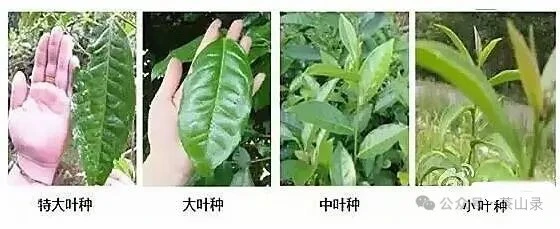
We can tell large-leaf tea plants apart from small-leaf ones through various aspects, ranging from visible appearance to internal chemical composition.
📏 1. Leaf Size: The Most Intuitive Judgement This is the fundamental classification standard. People usually measure the fully developed second or third leaf on new shoots. The calculating formula for leaf area is: Leaf Area (cm²) = Leaf Length (cm) × Leaf Width (cm) × 0.7 Tea varieties are divided into four groups according to the result:
• Extra large leaf: Leaf area over 60 cm² (or above 50 cm²). Representative: Yunnan large-leaf strains including Mengku and Fengqing large-leaf tea.
• Large leaf: Leaf area between 40–60 cm² (or 28–50 cm²). Representative: Menghai and Fengqing large-leaf tea from Yunnan.
• Medium leaf: Leaf area between 20–40 cm² (or 14–28 cm²). Representative: oolong tea such as Tieguanyin and Wuyi rock tea. • Small leaf: Leaf area no more than 20 cm². Representative: famous green tea including West Lake Longjing and Huangshan Maofeng.
🔬 2. Shape & Micro Structure: The Hidden Details
• Lateral veins: Large-leaf tea has more than 10 pairs of lateral veins, while medium and small-leaf types have fewer than 10 pairs.
• Texture & color: Large leaves are soft with thin cuticle layers, mostly yellowish green. Small leaves are stiff and crisp with thick cuticles, usually dark green.
• Microstructure: Large-leaf tea only has one loose layer of palisade tissue, plus big and sparse stomata on leaf backs. Small-leaf tea has 2 to 3 tight layers of palisade tissue, with tiny and dense stomata.
🧪 3. Internal Substances: Chemical Differences That Determine Tea Flavor
• Tea polyphenols: The main source of astringency. Large-leaf tea contains a very high level of polyphenols, exceeding 30%, while medium and small-leaf tea has a much lower proportion.
• Amino acids: Responsible for fresh and brisk taste. Small and medium-leaf tea contains several times more amino acids than large-leaf varieties.
• Caffeine: Creates bitter taste, and large-leaf tea has a higher caffeine content.
• Aroma compounds: Small and medium-leaf tea is richer in aromatic substances, so most high-fragrance teas are made from these varieties. 👅 4. Tasting Character & Suitable Processing Methods: Final Flavor Performance
• Taste difference: Tea made from large leaves is strong, full-bodied and can withstand many infusions. Small and medium-leaf tea tastes fresh, sweet and carries prominent top notes.
• Suitable processing: Thanks to abundant inner substances and high polyphenol content, large-leaf tea has great fermentation potential, ideal for making black tea, ripe Pu'er and dark tea. With rich amino acids and aromatic elements, small and medium-leaf tea is perfect for producing green tea, oolong tea and white tea.