In 2025, the export volume of Chinese tea exceeded the 400000 ton mark for the first time, reaching 418800 tons, setting a new historical high. However, at the same time, the reality that the average export price has decreased by 2.7 US dollars/kg year-on-year to 3.69 US dollars/kg cannot be ignored. What is the position of Chinese tea in the international market when the quantity is rising and the price is falling?
The overall situation of current international tea trade
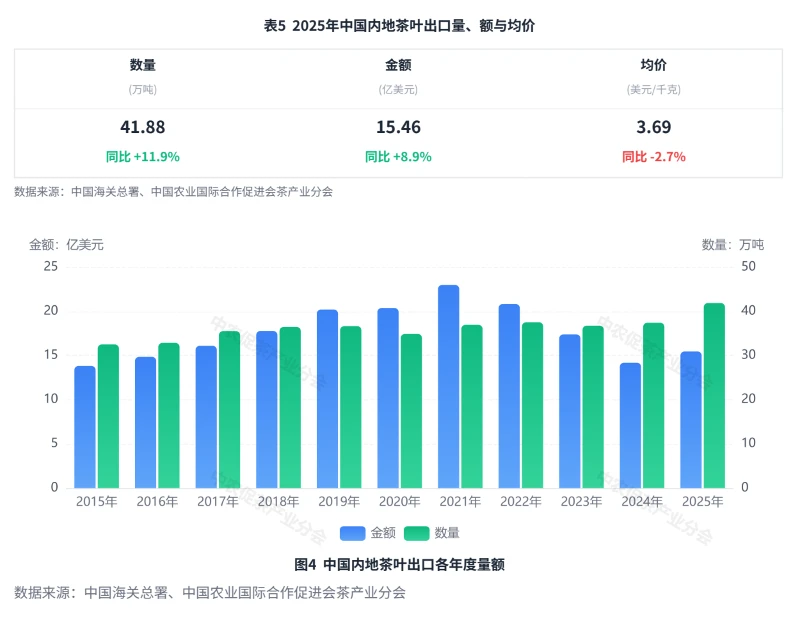
2025 is a milestone year for China's tea exports. According to data from the General Administration of Customs, the annual export volume was 418800 tons, a year-on-year increase of 11.93%; The export value was 1.546 billion US dollars, a year-on-year increase of 8.91%.
Behind the 'double increase in quantity and quantity', there is a signal worth being wary of - the average export price has dropped from $3.79/kg in 2024 to $3.69/kg. The export volume of green tea reached 369000 tons, accounting for 88.11% of the total export volume, with a year-on-year increase of 13.93%, but the average price was only 3.37 US dollars per kilogram. This indicates that our export growth is mainly driven by "running volume", and the proportion of high value-added products is still relatively low.
At the same time, the import side is also undergoing changes. In 2025, the import volume of Chinese tea will be 60700 tons, a year-on-year increase of 12.54%; The import volume was 184 million US dollars, a year-on-year increase of 17.12%. The import volume of black tea is 49100 tons, accounting for 80.89%. The average import price is 3.04 US dollars per kilogram, a year-on-year increase of 4.07% - imported tea is becoming increasingly expensive, while exported tea is becoming cheaper. This scissors gap is worth pondering by the entire industry.
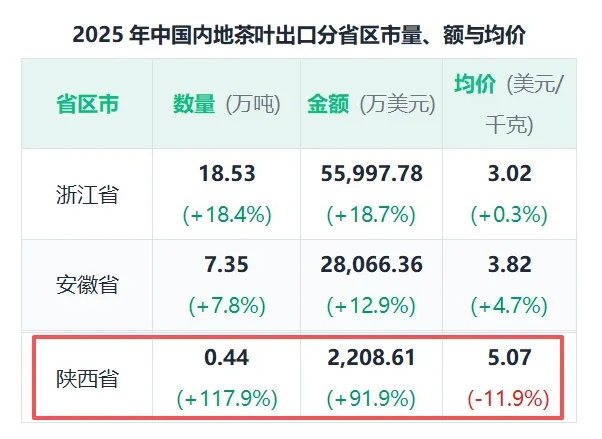
When everyone was staring at traditional wealthy families like Zhejiang and Anhui, Shaanxi Province quietly killed them. In 2025, the export volume increased by 117.9% year-on-year, and the export value increased by 91.9%. Kazakhstan, Uzbekistan, and Russia have supported its foundation - the three markets together account for nearly 70% of Shanxi's exports. Shanxi Tea is making use of the "the Belt and Road" channel to complete the leap from "piecemeal" to "large-scale sea going".
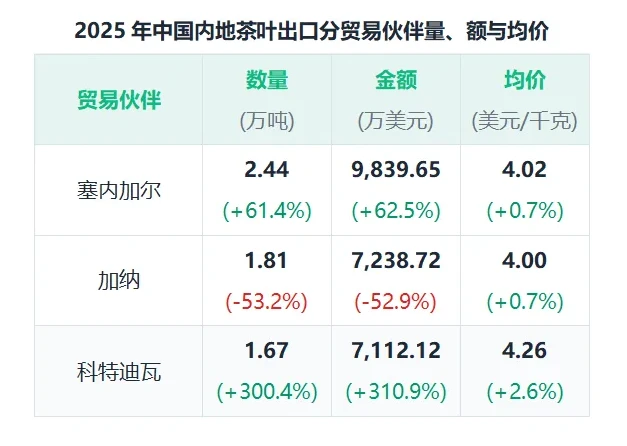
The Ghana market, which was still growing rapidly the previous year, will experience a sharp drop of 53.2% in tea imports from China by 2025, with the amount halved by more than half. During the same period, Côte d'Ivoire surged by 300%, and Senegal rose by over 60% - the African market is experiencing a dramatic "one goes and the other goes".
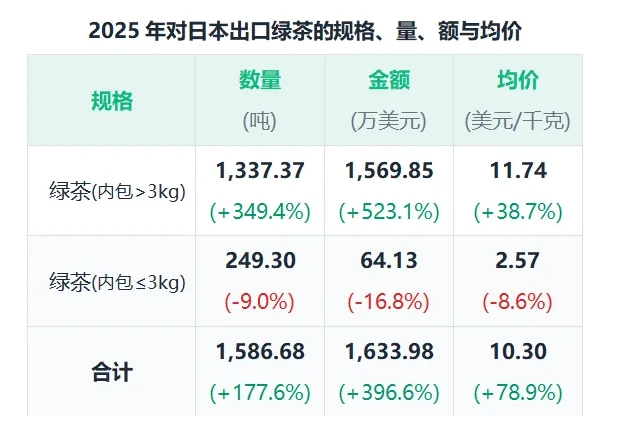
Although the quantity of green tea (small packaging, ≤ 3kg) exported to Japan is not large, the average price is as high as 11.74 US dollars per kilogram, which is 3.5 times the national average price of 3.37 US dollars for green tea. The export value has surged by 523% year-on-year. This indicates that Chinese tea has never been "unsold" in the high-end market, but rather not sold in the right way. Small packaging, branding, and precise advertising - this path is worth more companies taking seriously.
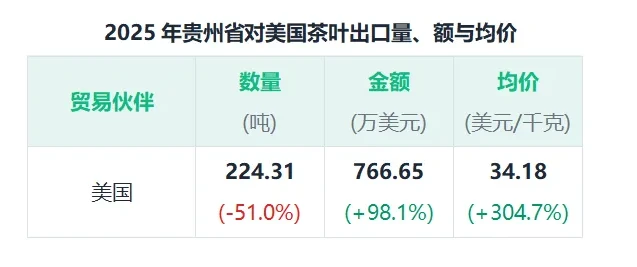
The overall export volume of Guizhou tea has declined, but the average export price to the United States has reached 34.18 US dollars per kilogram, a year-on-year increase of 304.7%, which is more than 9 times the national average price. The quantity is not large, but the profit is astonishing. This case tells us that in the international market, "doing the right market" is more important than "doing more markets". Even if you only enter a high net worth consumer circle, the return is enough to change the survival logic of the enterprise.
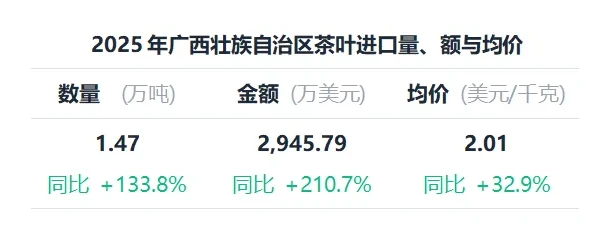
In 2025, the import volume of tea in Guangxi will be 14700 tons, a year-on-year increase of 133.8%, ranking first in the country. A large amount of black tea raw materials are imported from India and Vietnam, and after local processing, they may be re exported or supplied to the domestic new tea beverage market. China is not only a major exporter of tea, but also a global hub for tea processing and trade - this new role of "big in, big out" deserves a re examination by the entire industry.