TEA KNOWLEDGE · ARTICLE 41
Cloudiness is an observation-not a complete quality judgement
The most useful test separates the effects of leaf particles, water and brewing before deciding whether the tea is suitable.

Clarity is influenced by the tea, water, particles, concentration and temperature.
A cloudy cup has more than one possible cause
Fine leaf particles can remain suspended in the liquor. Hard-water minerals can interact with tea compounds. A strong infusion may also become cloudy as it cools. These effects are different from visible spoilage or foreign contamination.
Some tea styles naturally produce a clearer cup than others. A very fine or broken product may create more sediment even when the tea is fresh and clean.
| Possible cause | What you may see | Simple comparison |
|---|---|---|
| Fine particles | Sediment or suspended material. | Use a fine strainer. |
| Hard water | Cloudiness or surface film. | Brew with lower-mineral water. |
| Strong concentration | Deeper, heavier liquor. | Reduce leaf amount. |
| Cooling | Haze develops after the cup stands. | Observe hot and cooled samples. |
| Foreign contamination | Unexpected particles or odour. | Stop use and investigate. |

Strong local preparation can create a visually different cup from a standard tasting infusion.
Tea film can form on the surface
Research has shown that minerals in tap water can contribute to a thin surface film on tea. This may look unattractive but is not the same as mould. Water choice and clean teaware often reduce the effect.
✓
Use clean transparent cups.
✓
Compare the same tea with two water sources.
✓
Filter one cup and leave another unfiltered.
✓
Observe immediately and after cooling.
✓
Smell the tea before deciding whether the appearance is abnormal.
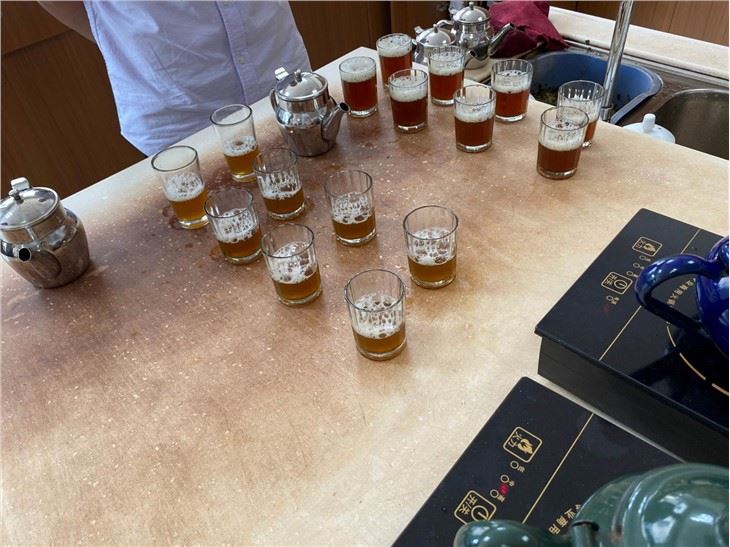
Controlled testing helps identify whether cloudiness comes from the product or the water.
Buyer rule
Clarity should be evaluated using the same water and brewing method that will be used in the market.
Need a cleaner or stronger liquor profile?
Share the local water conditions, preparation method and target colour with Jessie. Suitable tea styles can be compared.
jessie@hoututea.com · +86 18888798057
Reference basis: Peer-reviewed research on green-tea infusion quality, brewing water, minerals, tea film and tea-cream formation.